

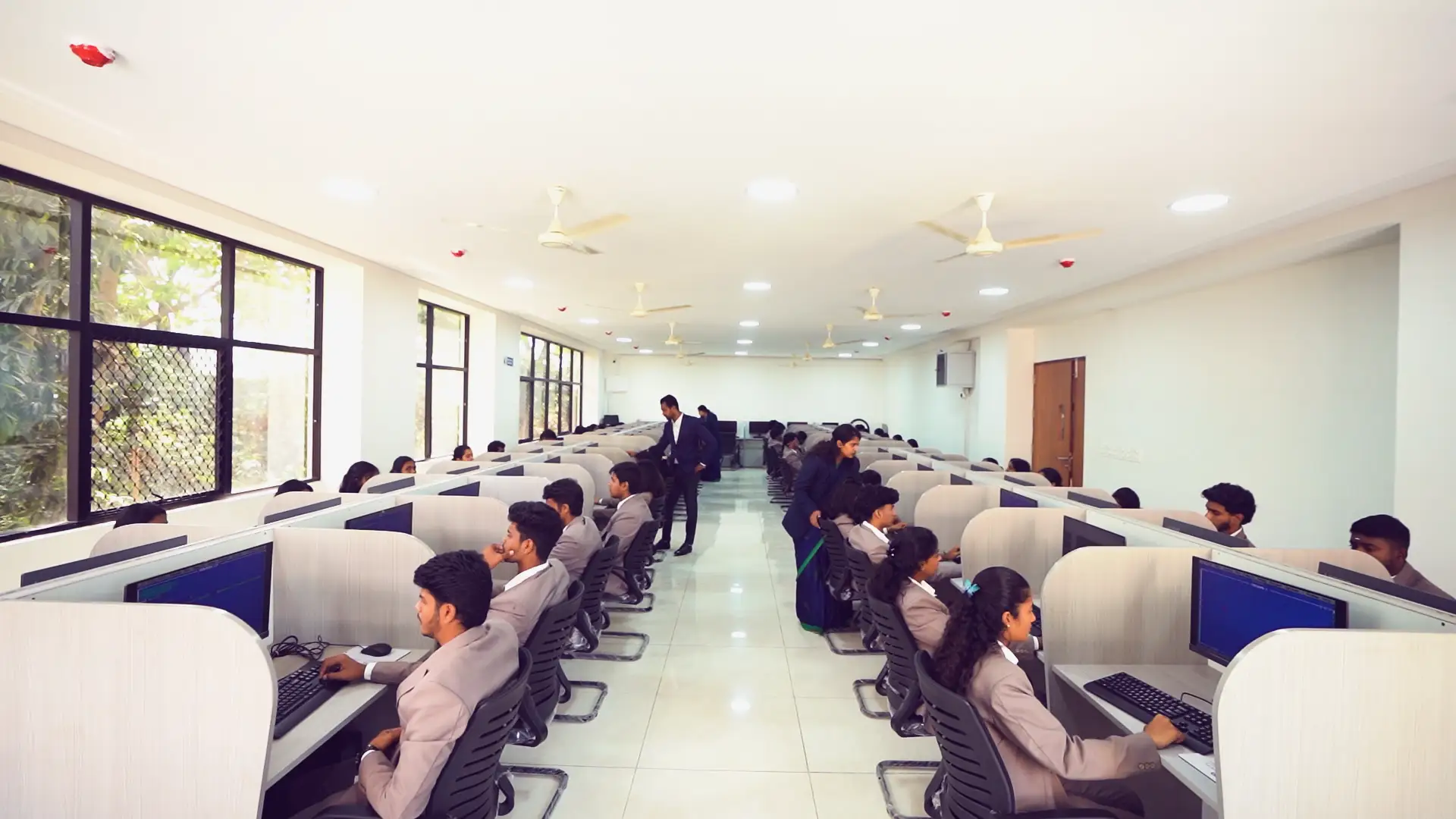
Bachelor of Computer Applications (BCA)
The Bachelor of Computer Applications (BCA) is a three-year full-time undergraduate programme designed to develop a strong foundation in computer science and applications, with a focus on both theoretical understanding and practical skills essential for the modern information technology environment.
The programme equips students to design, develop, implement, and maintain software solutions across sectors such as IT, finance, healthcare, e-commerce, and digital services. The curriculum integrates core computing subjects with skill enhancement components, project work, and industry-oriented activities to build strong analytical thinking, programming expertise, and problem-solving capabilities.
The BCA programme also prepares students for higher education and specialization certifications, with outcomes including competency in programming languages, database systems, networking, cybersecurity basics, software engineering principles, and emerging technologies.
Course Eligibility
Candidates must have:
- Successfully completed 10+2 (Higher Secondary) examination from a recognized board with a minimum of 50% aggregate marks (with applicable relaxations for reserved categories as per rules).
- Students from Science, Commerce, or Arts streams are eligible, with some preference given to candidates with Mathematics or Computer Science at the 10+2 level.
Add-On / Professional / Certified Courses
In addition to the core curriculum, students can opt for professional and add-on certification programmes to enhance employability:
- Certificate in Web Development and Full-Stack Technologies
- Professional Certification in Database Management (SQL / Oracle / MySQL)
- Cybersecurity Foundations and Ethical Hacking
- Cloud Computing Essentials
- Soft Skills Workshops
(Specific offerings may vary by affiliated college.)
Program Outcomes
National Education Policy (2020 Scheme)
Academic Year 2020 and onwards
PO1: Prepare students to apply knowledge of computer science, mathematics, and management in practice
PO2: Enhance programming skills of young IT professionals. PO3: Enable to become software and hardware entrepreneur
PO3: Acquiring knowledge on basics of Computer Science and ability to apply to design principles in the development of solutions for problems of varying complexity
PO4: Exhibiting strong skills required to program a computer for various issues and problems of day-to-day applications with thorough knowledge on programming languages of various levels
PO5: Must have a reasonably good communication knowledge both in oral and writing
Program Educational Objectives (Peos)
National Education Policy (2020 Scheme)
Academic Year 2020 and onwards
PEO1: Provide students with a strong foundation in computer science and its applications
PEO2: Equip students with analytical and problem-solving skills required to design, develop, and maintain computer software and systems
PEO3: To foster practical skills by providing laboratory work, projects, and internships, allowing students to apply their theoretical knowledge to practical situations, use various software and hardware tools, and gain hands-on experience
PEO4: Develop students’ creativity and innovation by exposing them to emerging technologies and cutting-edge research in the field of computer science
PEO5: Foster teamwork and communication skills among students by encouraging them to work on group projects and presentations
PEO6: Develop students’ managerial and leadership skills by providing them with a basic understanding of business and management principles and practices
PEO7: Prepare students for a successful career in the rapidly growing IT industry by providing them with hands-on experience through projects, internships, and industry collaborations
PEO8: Encourage students to pursue further studies in computer science or related fields
PEO9: Nurture students’ ethical and social responsibility by promoting values such as honesty, integrity, respect, and environmental awareness
Course Outcome
National Education Policy (2020 Scheme)
Academic Year 2020 and onwards
I SEMESTER
SUBJECT: PROBLEM SOLVING TECHNIQUES USING C
- CO1: Write efficient algorithms to solve various problems
- CO2: Understand and use various constructs of the programming language such as conditionals, iteration, and recursion
- CO3: Implement your algorithms to build programs in the C programming language
- CO4: Use data structures like arrays, linked lists, and stacks to solve various problems
- CO5: Use data structures like arrays, linked lists, and stacks to solve various problems
SUBJECT: SUBJECT DATA STRUCTURES USING C
- CO1: Understand the concept of Dynamic memory management, data types, algorithms, Big O notation
- CO2: Understand basic data structures such as arrays, linked lists, stacks and queues
- CO3: Describe the hash function and concepts of collision and its resolution methods
- CO4: Solve problem involving graphs, trees and heaps
- CO5: Apply Algorithm for solving problems like sorting, searching, insertion and deletion of data
Subject: Discrete Mathematics
- CO1: Perform operations on various discrete structures such as sets, functions, relations, and sequences
- CO2: Understand and apply propositional logics and predicates
- CO3: Ability to solve problems using Counting techniques, Permutation and Combination, Recursion and generating functions
- CO4: Perform operations on matrix and understand applications of matrix to solve linear equations
- CO5: Apply graphs and trees as tools to visualize and simplify Problems
Subject: C PROGRAMMING (PST) LAB
- CO1: Understand the usage of primitive and user defined data types and use them
- CO2: Understand the working of basic C constructs like loops and switch
- CO3: Ability to use single and multi-dimensional datatypes
- CO4: Demonstrate the usage of strings and their functions
- CO5: Build structure and union datatypes for real world applications
Subject: DATA STRUCTURES LAB
- CO1: Understand the concept of data structures and apply algorithm for solving problems like Sorting, searching, insertion and deletion of data
- CO2: Understand and implement linear data structures and their applications for processing of ordered or unordered data
- CO3: Explore various operations on dynamic data structures like single linked list, circular linked list and doubly linked list
- CO4: Explore the concept of nonlinear data structures such as binary search trees and heap trees
- CO5: Demonstrate operations on strings without using library functions
II SEMESTER
SUBJECT: OBEJECT ORIENTED PROGRAMMING USING JAVA
- CO1: Describe the procedural and object-oriented paradigm with concepts of streams, classes, functions, data, and objects
- CO2: Understand dynamic memory management techniques using pointers, constructors and destructors
- CO3: Describe the concept of function overloading, operator overloading, virtual functions, and polymorphism
- CO4: Classify inheritance with the understanding of early and late binding, usage of exception handling, generic programming
- CO5: Demonstrate the use of various OOPs concepts with the help of programs
SUBJECT: DATABASE MANAGEMENT SYSTEM
- CO1: Describe DBMS architecture, physical and logical database designs, database modelling, relational, hierarchical and network models
- CO2: Identify basic database storage structures and access techniques such as file organizations, indexing methods including B?tree, and hashing
- CO3: Learn and apply Structured query language (SQL) for database definition and database manipulation
- CO4: Demonstrate an understanding of normalization theory and apply such knowledge to the normalization of a database
- CO5: Understand various transaction processing, concurrency control mechanisms and database protection mechanisms
SUBJECT: COMPUTER ARCHITECTURE
- CO1: Explain the organization of basic computer, its design and the design of control unit
- CO2: Demonstrate the working of central processing unit and RISC and CISC Architecture
- CO3: Describe the operations and language f the register transfer, micro-operations, and input- output organization
- CO4: Understand the organization of memory and memory management hardware
- CO5: Elaborate advanced concepts of computer architecture, Parallel Processing, inter-processor communication and synchronization
SUBJECT: JAVA LAB
- CO1: Ability to write java programs for real world problems
- CO2: Develop web applications and standalone applications
- CO3: Demonstrate usage of constructors
- CO4: Ability to write applet programs and implement graphical user interface
- CO5: Implement threads, mouse and keyboard events
SUBJECT: DATABASE MANAGEMENT SYSTEM LAB
- CO1: Ability to convert ER diagrams to relational tables
- CO2: Identify normalization conditions and build normalized relational tables
- CO3: Perform various operations on a relational database such as Creating Tables (With and Without Constraints), Inserting/Updating/Deleting
- CO4: Ability to write and execute queries for given scenarios on a given relational database
- CO5: Demonstrate the knowledge of primary keys and foreign keys and their usages
III SEMESTER
SUBJECT: OPERATING SYSTEMS
- CO1: Learning the evolution, importance, concepts and structure of an operating system
- CO2: Analyzing scheduling algorithms, understanding need for process synchronization and methods of handling deadlocks
- CO3: Understanding efficient resource allocation w.r.t primary memory
- CO4: Understanding file management concepts and evaluating disk scheduling algorithms
- CO5: Getting familiarized with protection and security mechanisms
- CO6: Explain the various features of distributed OS like Unix, Linux, windows etc
SUBJECT: COMPUTER NETWORKS
- CO1: Understand computer network basics, network architecture, TCP/IP and OSI reference models
- CO2: Identify and understand various techniques and modes of transmission
- CO3: Describe data link protocols, multi-channel access protocols
- CO4: Describe routing and congestion in network layer with routing algorithms and classify IPV4 addressing scheme
- CO5: Discuss the elements and protocols of transport layer
- CO6: Understand network security and define various application layer protocols such as FTP, HTTP, Telnet, DNS
SUBJECT: PYTHON PROGRAMMING
- CO1: Interpret the fundamental Python syntax and semantics and be fluent in the use of Python control flow statements
- CO2: Express proficiency in the handling of strings and functions
- CO3: Determine the methods to create and manipulate Python programs by utilizing the data structures like lists, dictionaries, tuples and sets
- CO4: Identify the commonly used operations involving file systems and regular expressions
- CO5: Articulate the Object-Oriented Programming concepts such as encapsulation, inheritance and polymorphism as used in Python
SUBJECT: COMPUTER NETWORKING LAB
- CO1: Understand and use commands on CLI for network troubleshooting and traffic monitoring
- CO2: Study and understand real usages of different kinds of network components like cables, switches, routers and bridges
- CO3: Understand and configure IP addresses to network devices and design a LAN
- CO4: Ability to build hardware components like patch cords for LAN
- CO5: Understand and implement resource sharing in LAN such as hotspot configurations, sharing a printer and files
- CO6: Understand and configure windows security system like firewalls for blocking unwanted traffic
- CO7: Ability to use LAN design and simulation tool like Cisco Packet Tracer for configuring VLANs and VPNs
SUBJECT: PYTHON PROGRAMMING LAB
- CO1: Ability to program using Object Oriented concepts in python programming language
- CO2: Ability to work with different types of files. CO3: Ability to work with APIs and data visualization
IV SEMESTER
SUBJECT: SOFTWARE ENGINEERING
- CO1: Understanding the definition of software engineering and ethics of software engineers
- CO2: Ability to analyze the problem based on software engineer’s perspective, gathering the requirements to write SRS
- CO3: Implementing to produce architectural design and detail design of the software based on requirements and generate programming code
- CO4: To implement validation and verification process through software prototype developed and cost estimation
- CO5: Implementing the formal models to specify the behavior of systems and to experience the design of a system, also will be proficient in the basic techniques and tools for carrying out formal verification of software systems
SUBJECT: INTERNET TECHNOLOGY
- CO1: Comprehensive knowledge of Internet and its working
- CO2: Ability to use services offered by internet
- CO3: Skills to develop websites using HTML and DHTML
- CO4: Clear understanding of Web application frameworks
- CO5: Learn the research trends on web
SUBJECT: DESIGN AND ANALYSIS OF ALGORITHMS
- CO1: Analyze the computational complexity of different algorithms
- CO2: Develop the solution for given problems using divide and conquer and decrease and conquer methods
- CO3: Develop an algorithm using Greedy method and transform and conquer methods
- CO4: Develop the solution for given problems using Dynamic programming approach
- CO5: Develop the solution for given problems using Backtracking and Branch-and-Bound technique
SUBJECT: DESIGN AND ANALYSIS OF ALGORITHMS LAB
- CO1: Analyse the computational complexity of different algorithms
- CO2: Develop the solution for given problems using divide and conquer and decrease and conquer methods
- CO3: Develop an algorithm using Greedy method and transform and conquer methods
- CO4: Develop the solution for given problems using Dynamic programming approach
- CO5: Develop the solution for given problems using Backtracking and Branch-and-Bound technique
SUBJECT: INTERNET TECHNOLOGIES LAB
- CO1: Analyze a web page and identify its elements and attributes
- CO2: Develop the solution for given problems using divide and conquer and decrease and conquer methods
- CO3: Build dynamic web pages using JavaScript (Client side programming)
- CO4: Create XML documents and Schemas
V SEMESTER
SUBJECT: ARTIFICIAL INTELLIGENCE
- CO1: Understand the various characteristics of problem solving agents and apply problem solving through search for AI applications
- CO2: Appreciate the concepts of knowledge representation using Propositional logic and Predicate calculus and apply them for inference/reasoning
- CO3: Obtain insights about Planning and handling uncertainty through probabilistic reasoning and fuzzy systems
- CO4: Understand basics of computer vision and Natural Language Processing and understand their relevance in AI applications
- CO5: Obtain insights about machine learning, neural networks, deep learning networks and their significance
SUBJECT: DATA ANALYTICS
- CO1: Analyze and interpret large datasets to extract meaningful insights
- CO2: Apply statistical methods and data visualization techniques for effective data communication
- CO3: Develop proficiency in using data analytics tools and software
- CO4: Utilize predictive modeling and machine learning algorithms for data-driven decision-making
- CO5: Ethically handle and manage data to ensure privacy and security in analytics processes
SUBJECT: WEB PROGRAMMING
- CO1: Understand the basics of Web Programming concepts
- CO2: To build dynamic web pages with validation using JavaScript objects and by applying different event-handling mechanisms
- CO3: Analyze various PHP library functions that manipulate files and directories
- CO4: To develop modern interactive web applications using PHP and XML
SUBJECT: DATA MINING
- CO1: Identify the scope and necessity of Data Mining & Warehousing for the society
- CO2: Describe the designing of Data Warehousing so that it can be able to solve the root problems
- CO3: To understand various tools of Data Mining and their techniques to solve the real time problems
- CO4: To develop ability to design various algorithms based on data mining tools
- CO5: To develop further interest in research and design of new Data Mining techniques
SUBJECT: DATA ANALYTICS LAB
- CO1: Understand and implement the basics of data structures like Linked list, stack, queue, set and map in Java
- CO2: Demonstrate the knowledge of big data analytics and implement different file management task in Hadoop
- CO3: Understand Map Reduce Paradigm and develop data applications using variety of systems
- CO4: Analyze and interpret data using an ethically responsible approach
SUBJECT: WEB PROGRAMMING LAB
- CO1: Analyze a web page and identify its elements and attributes
- CO2: Create web pages using XHTML and Cascading Style Sheets
- CO3: Build dynamic web pages using JavaScript (Client side programming)
- CO4: Create XML documents and Schemas.
- CO5: To learn HTML tags and JavaScript Language programming concepts and techniques
- CO6: To develop the ability to logically plan and develop web pages
- CO7: To learn to write, test, and debug web pages using HTML and JavaScript
VI SEMESTER
SUBJECT: Machine Learning
- CO1: Learn the basics of machine learning, understanding its uses, challenges, and various applications
- CO2: Build practical data skills, covering data collection, analysis, visualization, and preparation
- CO3: Become skilled in using classification and regression algorithms, including selecting, training, and evaluating models
- CO4: Dive into advanced clustering and specialized applications, using methods like KMeans, DBSCAN, and others
SUBJECT: Mobile Application Development
- CO1: Understand the basic concepts of Mobile application development
- CO2: Design and develop user interfaces for the Android platforms
- CO3: Apply Java programming
SUBJECT: Electronic Content Design
- CO1: To deliver the content via various media such as radio, television, computer etc
- CO2: To increase students’ concentration on particular subject matter in depth learning
- CO3: To feel emotionally good with joyful learning and active learning involvement of students during the content delivery
- CO4: To reuse many time the content to various group of same class without hesitate and unchanging
- CO5: To handle easy to the facilitators during the content delivery
- CO6: To modify the content with present time needs
SUBJECT: SOFTWARE TESTING
- CO1: Differentiate the various testing techniques
- CO2: Derive Test Cases for any given problem
- CO3: Classify the problem into suitable testing models
- CO4: Apply a wide variety of testing techniques in an effective and efficient manner
- CO5: Explain the need for planning and monitoring a process
- CO6: To modify the content with present time needs
SUBJECT: Machine Learning Lab
- CO1: Achieve proficiency in setting up Python, installing vital libraries, and configuring essential tools
- CO2: Demonstrate competence in data manipulation, dataset loading, and the creation of insightful visualizations
- CO3: Exhibit the ability to preprocess data, address missing values, perform categorical encoding, and implement fundamental machine learning algorithms
- CO4: Develop an understanding of clustering techniques, create cluster visualizations, and interpret decision tree splits
SUBJECT: Mobile Application Development Lab
- CO1: Understand the basic concepts of Mobile application development
- CO2: Design and develop user interfaces for the Android platforms
- CO3: Apply Java programming
I Semester
| Course Code | Course title | Teaching hours | Credits |
|---|---|---|---|
| CA-C1T | Discrete Structure | 3 | 3 |
| CA-C2T | Problem solving Techniques | 3 | 3 |
| CA-C3T | Data Structure | 3 | 3 |
| CA-C4L | Problem solving Lab | 2 | 2 |
| CA-C5L | Data Structure Lab | 2 | 2 |
| Languages, Skill Enhancement (SEC), and Ability Enhancement Course | OE1: Open Elective | 3 | 3 |
| Language L1 | 3 | 3 | |
| Language L2 | 3 | 3 | |
| SEC Office Management Tools | 2 | 2 | |
| Health & Wellness | 1 | 1 | |
| Physical Education | 1 | 1 | |
| Total Credits | 26 | 26 |
II Semester
| Course Code | Course title | Teaching hours | Credits |
|---|---|---|---|
| CA-C6T | Computer Architecture | 3 | 3 |
| CA-C7T | Object Oriented Programming using Java | 3 | 3 |
| CA-C8T | Database Management System | 3 | 3 |
| CA-C9L | Java Lab | 2 | 2 |
| CA-C10L | Database Management System Lab | 2 | 2 |
| Languages, Skill Enhancement (SEC), and Ability Enhancement Courses | OE2: Open Elective | 3 | 3 |
| Language L1 | 3 | 3 | |
| Language L2 | 3 | 3 | |
| Environmental studies | 2 | 2 | |
| Physical Education | 1 | 1 | |
| NCC/NSS/CL/R-R | 1 | 1 | |
| Total Credits | 26 | 26 |
III Semester
| Course Code | Course title | Teaching hours | Credits |
|---|---|---|---|
| CA-C11T | Operating Systems | 3 | 3 |
| CA-C12T | Computer Networks | 3 | 3 |
| CA-C13T | Python Programming | 3 | 3 |
| CA-C14L | Computer Networks Lab | 2 | 2 |
| CA-C15L | Python Programming Lab | 2 | 2 |
| Languages, Skill Enhancement (SEC), and Ability Enhancement Courses | OE3: Open Elective | 3 | 3 |
| Language L1 | 3 | 3 | |
| Language L2 | 3 | 3 | |
| SEC II: Computer Assembly and Repair | 2 | 2 | |
| Physical Education | 1 | 1 | |
| NCC/NSS/CL/R-R | 1 | 1 | |
| Total Credits | 26 | 26 |
IV Semester
| Course Code | Course title | Teaching hours | Credits |
|---|---|---|---|
| CA-C16T | Software Engineering | 3 | 3 |
| CA-C17T | Design and Analysis of Algorithm | 3 | 3 |
| CA-C18T | Internet Technologies | 3 | 3 |
| CA-C19L | Design and Analysis of Algorithm Lab | 2 | 2 |
| CA-C20L | Internet Technologies Lab | 2 | 2 |
| Languages, Skill Enhancement (SEC), and Ability Enhancement Courses | OE4: Open Elective | 3 | 3 |
| Language L1 | 3 | 3 | |
| Language L2 | 3 | 3 | |
| The Constitution of India | 2 | 2 | |
| Physical Education | 1 | 1 | |
| NCC/NSS/CL/R-R | 1 | 1 | |
| Total Credits | 26 | 26 |
V Semester
| Course Code | Course title | Teaching hours | Credits |
|---|---|---|---|
| CA-C21T | Artificial Intelligence | 4 | 4 |
| CA-C22T | Data Analytics | 3 | 3 |
| CA-C23T | Web programming | 4 | 4 |
| CA-C24L | Data Analytics lab | 2 | 2 |
| CA-C25L | Web programming lab | 2 | 2 |
| SKILL Enhancement (SEC) and Ability Enhancement courses | CA-VI Vocational course1: quantitative techniques | 3 | 3 |
| Elective I | 3 | 3 | |
| SEC III | 3 | 3 | |
| Total Credits | 25 | 25 |
VI Semester
| Course Code | Course title | Teaching hours | Credits |
|---|---|---|---|
| CA-C26P | Project Work | 4 | 4 |
| CA-C27T | Machine Learning | 3 | 3 |
| CA-28T | Mobile Application Development | 4 | 4 |
| CA-29L | Machine Learning Lab | 2 | 2 |
| CA-30L | Mobile Application Lab | 2 | 2 |
| SKILL Enhancement (SEC) and Ability Enhancement courses | CA-VI Vocational course1: quantitative techniques | 3 | 3 |
| Elective II | 3 | 3 | |
| Internship | 2 | 2 | |
| Total Credits | 24 | 24 |
BCA (Full Stack Development)
| Sem | Course/ Paper Code | Title of the Paper | Teaching Hours / Week | Semester End Exam | Internal Assessment | Total Marks | Credits |
|---|---|---|---|---|---|---|---|
| 1 | 24BCA11 | Discrete Structures | 03 | 80 | 20 | 100 | 3 |
| 24BCA12 | Problem-Solving Technique | 03 | 80 | 20 | 100 | 3 | |
| 24BCA13 | Computer Architecture | 03 | 80 | 20 | 100 | 3 | |
| 24BCA12P | Problem-Solving Technique Lab | 04 | 40 | 10 | 50 | 2 | |
| 24BCA13P | Computer Architecture Lab | 04 | 40 | 10 | 50 | 2 | |
| 24BCA1P | Office Automation Tools | 04 | 40 | 10 | 50 | 2 | |
| 24BCAL11 | Language L1 | 04 | 80 | 20 | 100 | 3 | |
| 24BCAL12 | Language L2 | 04 | 80 | 20 | 100 | 3 | |
| 2 | 24BCA21 | Data Structure | 03 | 80 | 20 | 100 | 3 |
| 24BCA22 | Object-Oriented Programming Using JAVA | 03 | 80 | 20 | 100 | 3 | |
| 24BCA23 | Operating Systems | 03 | 80 | 20 | 100 | 3 | |
| 24BCA21P | Data Structure Lab | 04 | 40 | 10 | 50 | 2 | |
| 24BCA22P | Object-Oriented Programming Lab | 04 | 40 | 10 | 50 | 2 | |
| 24BCA21P | LINUX and Shell Programming Lab | 04 | 40 | 10 | 50 | 2 | |
| 24BCAL21 | Language L1 | 04 | 80 | 20 | 100 | 3 | |
| 24BCAL22 | Language L2 | 04 | 80 | 20 | 100 | 3 | |
| 24BACCC2 | Environmental Studies | 02 | 40 | 10 | 50 | 2 |
BCA (AI-ML)
| Sem | Course/ Paper Code | Title of the Paper | Teaching Hours / Week | Semester End Exam | Internal Assessment | Total Marks | Credits |
|---|---|---|---|---|---|---|---|
| 1 | 24BCA11 | Discrete Structures | 03 | 80 | 20 | 100 | 3 |
| 24BCA12 | Problem-Solving Technique | 03 | 80 | 20 | 100 | 3 | |
| 24BCA13 | Computer Architecture | 03 | 80 | 20 | 100 | 3 | |
| 24BCA12P | Problem-Solving Technique Lab | 04 | 40 | 10 | 50 | 2 | |
| 24BCA13P | Computer Architecture Lab | 04 | 40 | 10 | 50 | 2 | |
| 24BCA1P | Office Automation Tools | 04 | 40 | 10 | 50 | 2 | |
| 24BCAL11 | Language L1 | 04 | 80 | 20 | 100 | 3 | |
| 24BCAL12 | Language L2 | 04 | 80 | 20 | 100 | 3 | |
| 2 | 24BCA21 | Data Structure | 03 | 80 | 20 | 100 | 3 |
| 24BCA22 | Object-Oriented Programming Using JAVA | 03 | 80 | 20 | 100 | 3 | |
| 24BCA23 | Operating Systems | 03 | 80 | 20 | 100 | 3 | |
| 24BCA21P | Data Structure Lab | 04 | 40 | 10 | 50 | 2 | |
| 24BCA22P | Object-Oriented Programming Lab | 04 | 40 | 10 | 50 | 2 | |
| 24BCA21P | LINUX and Shell Programming Lab | 04 | 40 | 10 | 50 | 2 | |
| 24BCAL21 | Language L1 | 04 | 80 | 20 | 100 | 3 | |
| 24BCAL22 | Language L2 | 04 | 80 | 20 | 100 | 3 | |
| 24BACCC2 | Environmental Studies | 02 | 40 | 10 | 50 | 2 | |
| 3 | 24BCA31 | Database Management System | 03 | 80 | 20 | 100 | 3 |
| 24BCA32 | Probability and Statistics | 04 | 80 | 20 | 100 | 4 | |
| 24BCA33 | Artificial Intelligence | 04 | 80 | 20 | 100 | 4 | |
| 24BCA31P | Database Management System Lab | 04 | 40 | 10 | 50 | 2 | |
| 24BCA32P | Artificial Intelligence Lab using Python | 04 | 40 | 10 | 50 | 2 | |
| 24BCAE1 | Elective I: Feature Engineering | 02 | 40 | 10 | 50 | 2 | |
| 24BCAL31 | Language L1 | 04 | 80 | 20 | 100 | 3 | |
| 24BCAL32 | Language L2 | 04 | 80 | 20 | 100 | 3 | |
| 4 | 24BCA41 | Computer Networks | 03 | 80 | 20 | 100 | 3 |
| 24BCA42 | Design and Analysis of Algorithms | 04 | 80 | 20 | 100 | 4 | |
| 24BCA43 | Software Engineering | 04 | 80 | 20 | 100 | 4 | |
| 24BCA41P | Computer Networks Lab | 04 | 40 | 10 | 50 | 2 | |
| 24BCA42P | Design and Analysis of Algorithms Lab | 04 | 40 | 10 | 50 | 2 | |
| 24BCAE2 | Elective II: Introduction to ML | 02 | 40 | 10 | 50 | 2 | |
| 24BCAL41 | Language L1 | 04 | 80 | 20 | 100 | 3 | |
| 24BCAL42 | Language L2 | 04 | 80 | 20 | 100 | 3 | |
| 24BCASEC1 | Office Management Tools | 02 | 40 | 10 | 50 | 2 | |
| 5 | 24BCA51 | ML and Neural Network | 03 | 80 | 20 | 100 | 3 |
| 24BCA52 | Digital Image Processing | 03 | 80 | 20 | 100 | 3 | |
| 24BCA53 | Natural Language Processing | 03 | 80 | 20 | 100 | 3 | |
| 24BCA51P | ML and Neural Network Lab | 04 | 40 | 10 | 50 | 2 | |
| 24BCA52P | Digital Image Processing Lab | 04 | 40 | 10 | 50 | 2 | |
| 24BCA53P | Natural Language Processing Lab | 04 | 40 | 10 | 50 | 2 | |
| 24BCASEC2 | Quantative Techniques | 02 | 40 | 10 | 50 | 2 | |
| 6 | 24BCA61 | Deep Learning for Computer Vision | 05 | 80 | 20 | 100 | 5 |
| 24BCA62 | Predictive Analysis | 05 | 80 | 20 | 100 | 5 | |
| 24BCA63 | Project Work | 10 | 80 | 20 | 100 | 5 | |
| 24BCASEC3 | Soft Skills | 02 | 40 | 10 | 50 | 2 |
BCA (Data Science)
| Sem | Course/ Paper Code | Title of the Paper | Teaching Hours / Week | Semester End Exam | Internal Assessment | Total Marks | Credits |
|---|---|---|---|---|---|---|---|
| 1 | 24BCA11 | Discrete Structures | 03 | 80 | 20 | 100 | 3 |
| 24BCA12 | Problem-Solving Technique | 03 | 80 | 20 | 100 | 3 | |
| 24BCA13 | Computer Architecture | 03 | 80 | 20 | 100 | 3 | |
| 24BCA12P | Problem-Solving Technique Lab | 04 | 40 | 10 | 50 | 2 | |
| 24BCA13P | Computer Architecture Lab | 04 | 40 | 10 | 50 | 2 | |
| 24BCA1P | Office Automation Tools | 04 | 40 | 10 | 50 | 2 | |
| 24BCAL11 | Language L1 | 04 | 80 | 20 | 100 | 3 | |
| 24BCAL12 | Language L2 | 04 | 80 | 20 | 100 | 3 | |
| 2 | 24BCA21 | Data Structure | 03 | 80 | 20 | 100 | 3 |
| 24BCA22 | Object-Oriented Programming Using JAVA | 03 | 80 | 20 | 100 | 3 | |
| 24BCA23 | Operating Systems | 03 | 80 | 20 | 100 | 3 | |
| 24BCA21P | Data Structure Lab | 04 | 40 | 10 | 50 | 2 | |
| 24BCA22P | Object-Oriented Programming Lab | 04 | 40 | 10 | 50 | 2 | |
| 24BCA21P | LINUX and Shell Programming Lab | 04 | 40 | 10 | 50 | 2 | |
| 24BCAL21 | Language L1 | 04 | 80 | 20 | 100 | 3 | |
| 24BCAL22 | Language L2 | 04 | 80 | 20 | 100 | 3 | |
| 24BACCC2 | Environmental Studies | 02 | 40 | 10 | 50 | 2 | |
| 3 | 24BCA31 | Database Management System | 03 | 80 | 20 | 100 | 3 |
| 24BCA32 | Probability and Statistics | 04 | 80 | 20 | 100 | 4 | |
| 24BCA33 | Artificial Intelligence | 04 | 80 | 20 | 100 | 4 | |
| 24BCA31P | Database Management System Lab | 04 | 40 | 10 | 50 | 2 | |
| 24BCA32P | Artificial Intelligence Lab using Python | 04 | 40 | 10 | 50 | 2 | |
| 24BCAE1 | Elective I: Basics of Data Analytics Using Spreadsheet | 02 | 40 | 10 | 50 | 2 | |
| 24BCAL31 | Language L1 | 04 | 80 | 20 | 100 | 3 | |
| 24BCAL32 | Language L2 | 04 | 80 | 20 | 100 | 3 | |
| 4 | 24BCA41 | Computer Networks | 03 | 80 | 20 | 100 | 3 |
| 24BCA42 | Design and Analysis of Algorithms | 04 | 80 | 20 | 100 | 4 | |
| 24BCA43 | Software Engineering | 04 | 80 | 20 | 100 | 4 | |
| 24BCA41P | Computer Networks Lab | 04 | 40 | 10 | 50 | 2 | |
| 24BCA42P | Design and Analysis of Algorithms Lab | 04 | 40 | 10 | 50 | 2 | |
| 24BCAE2 | Elective II: Data Visualization | 02 | 40 | 10 | 50 | 2 | |
| 24BCAL41 | Language L1 | 04 | 80 | 20 | 100 | 3 | |
| 24BCAL42 | Language L2 | 04 | 80 | 20 | 100 | 3 | |
| 24BCASEC1 | Office Management Tools | 02 | 40 | 10 | 50 | 2 | |
| 5 | 24BCA51 | Introduction to Data Science | 03 | 80 | 20 | 100 | 3 |
| 24BCA52 | Time Series Analysis | 03 | 80 | 20 | 100 | 3 | |
| 24BCA53 | Machine Learning | 03 | 80 | 20 | 100 | 3 | |
| 24BCA51P | Data Science Lab | 04 | 40 | 10 | 50 | 2 | |
| 24BCA52P | Time Series Analysis Lab | 04 | 40 | 10 | 50 | 2 | |
| 24BCA53P | Machine Learning Lab | 04 | 40 | 10 | 50 | 2 | |
| 24BCASEC2 | Quantative Techniques | 02 | 40 | 10 | 50 | 2 | |
| 6 | 24BCA61 | Big Data Analytics | 05 | 80 | 20 | 100 | 5 |
| 24BCA62 | Exploratory Data Analysis | 05 | 80 | 20 | 100 | 5 | |
| 24BCA63 | Project Work | 10 | 80 | 20 | 100 | 5 | |
| 24BCASEC3 | Soft Skills | 02 | 40 | 10 | 50 | 2 |
Career Opportunitues After BCA
A BCA degree opens up diverse career opportunities in the information technology sector.
Common Job Roles
- Software Developer / Programmer
- Web Application Developer
- Database Administrator (DBA)
- System Analyst
- Network Engineer
- IT Support Specialist
- Cybersecurity Analyst (Entry-Level)
- Mobile App Developer
- Technical Consultant